





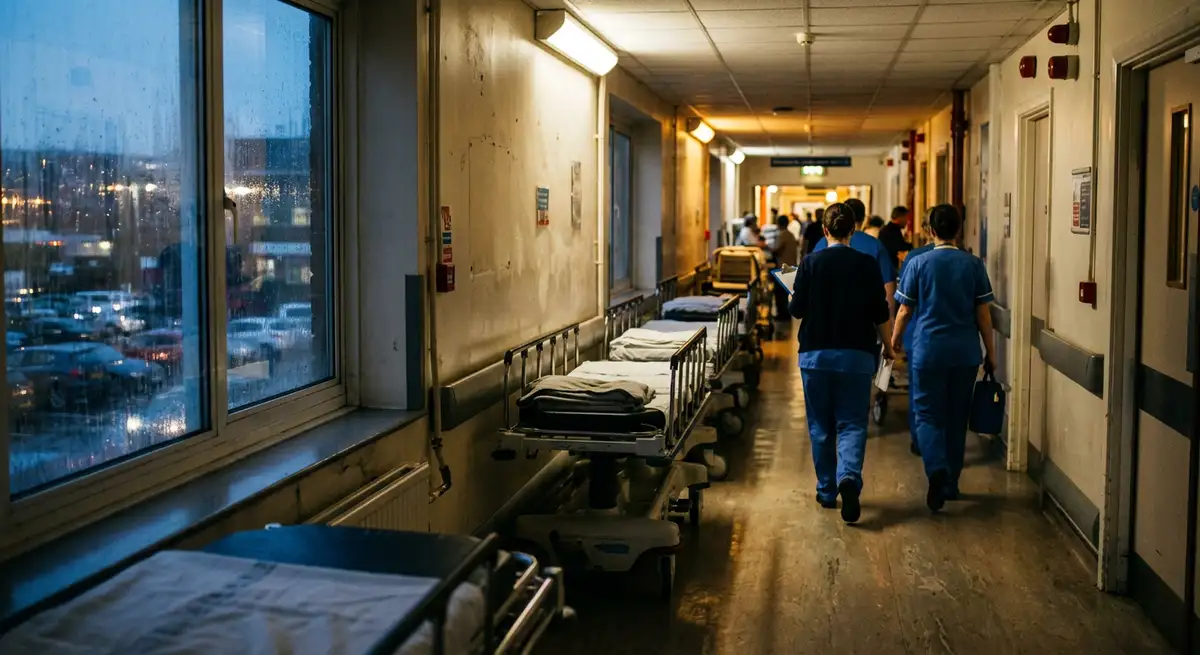
A survey of 184 NHS leaders finds most fear demand will outstrip capacity this winter, while dozens of hospital trusts in England say cost-cutting targets threaten their ability to function normally.
The NHS in England is heading into what its own leaders expect to be the busiest winter it has ever faced, with services “stretched to the limit” and money tighter than it has been for years.
A poll of 184 trust, integrated care board and primary care leaders by the membership body NHS Alliance found that 58% believe their local system lacks the capacity to meet the demand expected in the coming months. Almost four in five (79%) said the health service cannot recover its waiting time targets and deliver the government’s planned reforms at the same time on current funding.
The warnings come days after a Guardian investigation found that 31 NHS trusts have formally listed demands to make large savings this year as a threat to their ability to keep running normally.
“This winter will be busier”
Speaking anonymously as the survey was released, health chiefs described a service under strain on almost every front. “Last winter was the busiest winter on record. This winter will be busier. Therefore, this winter will be the busiest on record,” one trust boss said, according to the Independent.
Several leaders said the government’s ambition to move care out of hospitals and into the community had arrived too late to help this year. “We are dangerously late, I think, in terms of trying to shift care outside of hospital,” one said, adding that there was “no plan for the investment in community and primary care services in order to do that”. The same leader warned that A&E departments could “become overwhelmed” before alternatives to admission are in place, pointing to the growing number of people aged over 65 and over 85.
Staffing was the leaders’ biggest worry. Healthcare Leader reported that 87% were concerned about staff burnout, 86% about morale and 80% about sickness absence, while 78% were worried about the impact of cuts to headcount. Half did not believe the NHS will be able to meet its constitutional standards over the next five years.
Sir Ciarán Devane, chief executive of NHS Alliance, said: “Local NHS leaders are warning that the hard-fought gains of recent years are in peril due to a series of extra costs that are not covered in the budget.” He pointed to the cost of industrial action and pay settlements, higher-than-expected inflation, rising energy and medicines bills and continued growth in demand since the 2025 Spending Review.
Trusts forced into “unpalatable” cuts
The financial picture behind those warnings is stark. The Guardian found that 27 of the 31 trusts flagging savings demands as a risk rate a lack of money as the single biggest threat they face. Six, including King’s College hospital trust and the St George’s, Epsom and St Helier group in London, gave it the highest possible score of 25 on their risk registers.
Some savings programmes run to more than £100m. Nottingham University Hospitals trust plans to reduce its workforce by 1,279 to help meet a £106m target, and Barts Health in London aims to cut 1,100 posts. Torbay and South Devon trust is removing 199 non-clinical roles and told its board it would consider “unpalatable” and high-risk options to meet its plan.
The cuts are already reaching patients. York and Scarborough trust said in September it would close a 28-bed step-down ward at Bridlington community hospital to save £1m, while Sherwood Forest trust’s plan to shut a hydrotherapy pool at King’s Mill hospital has prompted an outcry. Harrogate and district trust is ending out-of-hours GP care in Hambleton and Richmond after 15 years.
One chief executive told the paper that NHS finances were “as tough as they have ever been”, adding: “Very few trusts will break even and many will miss their financial plan for this year.” NHS England said organisations were “working hard to improve productivity, live within their means and make the best use of taxpayers’ money”, and noted the service balanced its budget last year for the first time in more than a decade.
What the government is doing
Ministers have put extra money towards the coming months. A House of Commons Library briefing on winter preparedness lists a £140m investment in 14 urgent care schemes announced in October, an additional £190m for NHS England in the Autumn Budget to manage winter pressures, and a £40m programme announced on 9 November for GPs to support up to 300,000 vulnerable patients at home.
A Department of Health and Social Care spokesperson said: “After the record levels of demand placed on the NHS this summer, we all understand how challenging this winter is going to be.” The department said its new neighbourhood support teams would in future transform care for almost two million people in England with the greatest needs.
Unions and charities say that is not enough. Professor Nicola Ranger, general secretary of the Royal College of Nursing, said it was “incredibly worrying to hear service leaders speak of cutting back services further in England”, warning that registered nurse roles in hospitals were already being reduced.
What it means for UK readers
For patients in England, the leaders’ warnings point to longer waits in A&E, more pressure on beds and, in some areas, fewer local services as trusts try to balance their books. The government’s target of treating 92% of planned-care patients within 18 weeks by July 2029 also looks under threat; one trust leader said that “as things stand, it looks unlikely” to be met.
What happens next will depend on how hard the cold weather bites and whether trusts can hold their savings plans without further cuts. Hospitals have been told by NHS England to stop overspending, and MPs are due to debate nursing staff numbers in Westminster Hall on 1 December.