




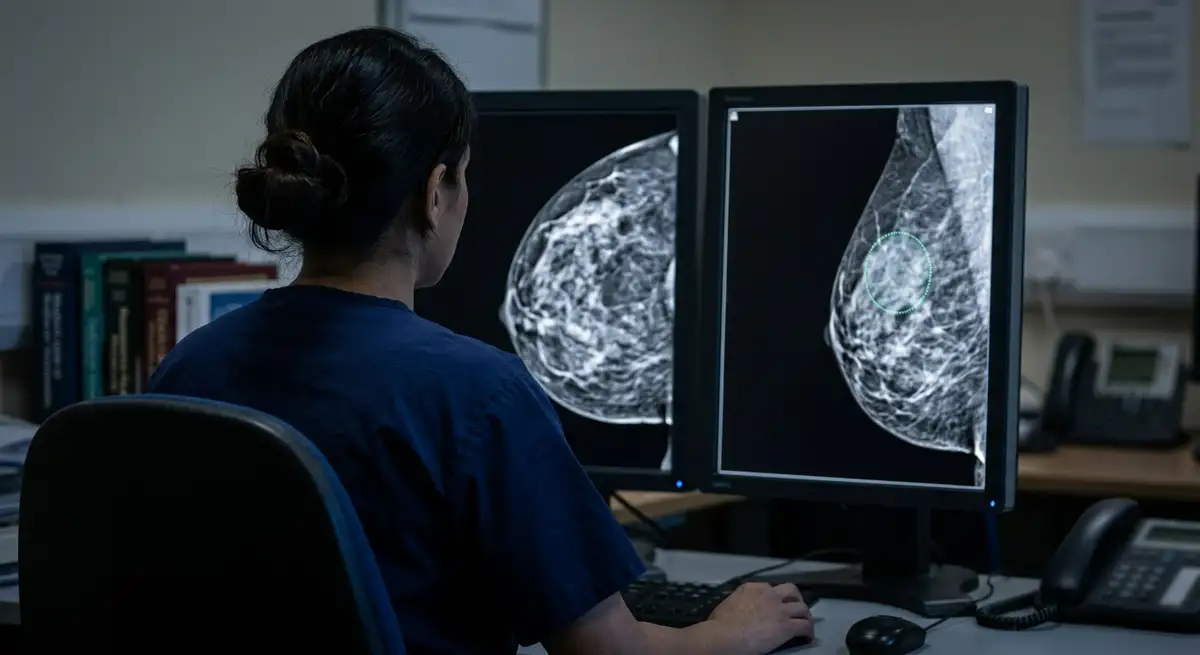
The NHS has begun inviting women to the world’s largest trial of artificial intelligence in breast cancer screening. The study will test whether software can take on part of a job that two specialists currently share on every mammogram.
The trial is called EDITH, short for Early Detection using Information Technology in Health. It is expected to involve nearly 700,000 women who attend routine NHS breast screening over the next three years. NHS England announced on 23 November that the first invitations had gone out, with recruitment starting at Cambridge University Hospitals. It is the first of 30 sites across the UK, and more will open in the coming months.
The £10 million study is funded by the government through the National Institute for Health and Care Research (NIHR). It is led by the University of Warwick, the University of Cambridge and Cambridge University Hospitals NHS Foundation Trust, working with NHS England.
How the trial will work
For the women taking part, the appointment itself will not change. They will be invited for screening in the usual way, and the letter will explain the trial and give them the option to opt out.
The difference is in what happens to the images afterwards. At present, two trained readers look at every mammogram. EDITH will test whether an AI tool can safely stand in for one of them, so that most images need to be checked by only one specialist. According to the BBC’s medical editor Fergus Walsh, the trial has two arms. In one, the AI grades the images before NHS experts see them. In the other, it reviews them afterwards. Four AI companies are involved.
The researchers say they have tested four AI systems for accuracy. Professor Sian Taylor-Phillips of the University of Warwick, one of the trial’s two co-chief investigators, said: “Importantly, all clinical decisions during EDITH will remain with NHS staff.”
She told the BBC the team also wants to avoid “the overdiagnosis of milder disease that would never have caused symptoms”. Earlier, smaller studies suggested AI can raise cancer detection rates. The open question is whether it does this without sending more women back for further tests they did not need.
The other co-chief investigator, Professor Fiona Gilbert of the University of Cambridge, said: “Millions of women have a mammogram each year and only a small number, less than 1%, will have cancer.” She told the BBC there was a “huge shortfall” in radiologists, and that the number of imaging examinations was rising by 8% a year.
Why it matters
NHS England says breast cancer is the most common cancer in women, with around 55,000 diagnosed every year. Women aged 50 to 71 are invited for screening every three years. That adds up to around 2.1 million screenings a year, and the programme is estimated to prevent around 1,300 deaths annually. Breast Cancer Now estimates that a third of breast cancers in England are found through screening, most of them at an early stage.
Health and Social Care Secretary Yvette Cooper visited the trial team at Addenbrooke’s Hospital in Cambridge. She said: “This is the biggest AI breast cancer trial in the world, backed by £10 million of government investment to speed up diagnosis and potentially deliver life-saving improvements.” She added: “AI has huge potential, but we also need proper safeguards in place to make sure we’re using it safely and effectively to improve treatment and research.”
Professor Peter Johnson, NHS England’s national clinical director for cancer, urged women to take part. He said “every scan will still be seen by a specialist”. If the trial succeeds, NHS England says it could free up hundreds of radiologists and other specialists to see more patients who need cancer tests and treatment.
Radiologists welcomed the trial but warned against treating it as a fix for staff shortages. Dr Stephen Harden, President of the Royal College of Radiologists, said more than a fifth of the breast radiology workforce is due to retire by 2030. He also said the workforce has grown by an average of only 2% over the past five years. “This trial has real potential to free up radiologists’ time, but it won’t be a quick fix to the immediate need for more radiologists to ensure patients can get prompt answers about their health,” he said.
What it means for UK readers
Women invited to routine screening at a participating site will find information about EDITH in their invitation letter. They do not need to do anything to take part, and they can opt out if they prefer. The scan, the appointment and the way results are given will stay the same. If an abnormal result is found, women will still be referred for further tests in the usual way.
The trial starts in the middle of a wider debate about how quickly the health service can adopt new technology. On 26 November, the House of Lords Science and Technology Committee published a report titled Innovation in the NHS: Personalised Medicine and AI – lost opportunities? It found that the NHS “does not have an innovation problem” but struggles to adopt proven innovations. It said promising technologies too often fail to move beyond pilots into wider use.
The committee’s recommendations include funding and commissioning innovations nationally rather than relying on “endless pilots”. It also called for ring-fenced budgets to scale up ideas that work and for more powers for the medicines regulator, the MHRA, to regulate AI as a medical device. The government must respond by 26 January 2027.
What happens next
Recruitment will widen over the coming months as more of the 30 screening sites open, and thousands more women are expected to receive invitations. The trial is set to run for around three years. Its results will help decide whether AI-assisted reading becomes a standard part of the NHS Breast Screening Programme.
Professor Kevin Dunbar, NHS England’s deputy director of public health, said EDITH would “help build the evidence we need, while ensuring patient safety, quality and the expertise of screening professionals remain at the heart of the programme”.
Until the evidence is in, the advice from clinicians and charities stays the same: anyone invited for breast screening should attend.