




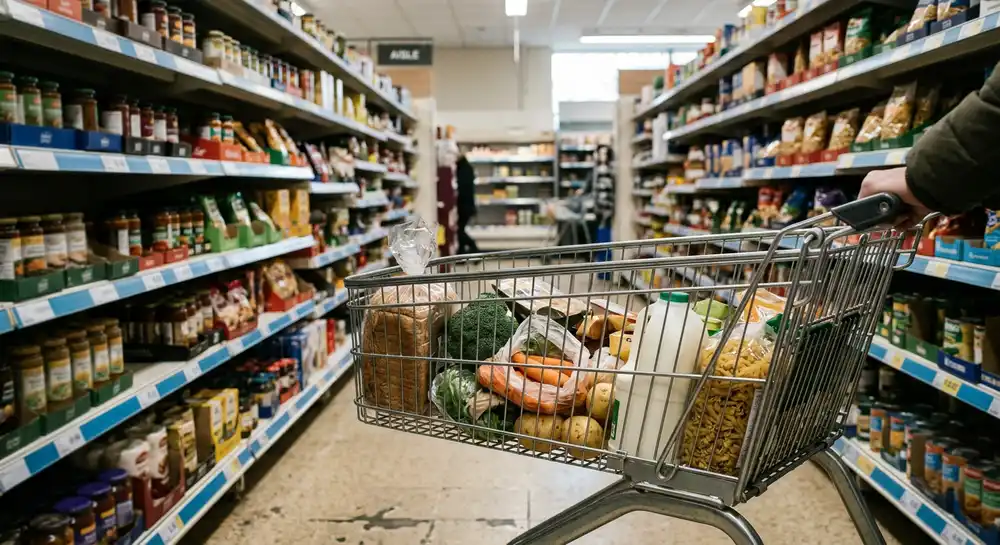
Food prices in the UK are rising at their slowest pace in five years, but the Bank of England has warned households that the respite is unlikely to last, with grocery inflation expected to climb to between 3% and 5% by the middle of next year.
Clare Lombardelli, the Bank’s deputy governor, told MPs on the Treasury select committee this week that food inflation had come in below what both the Bank and the industry had expected, despite the cost pressures that followed the start of the Iran war. She cautioned, however, that the pressure on prices had not gone away.
“We think that … it will go up to 3 to 5% in the middle of next year. I mean, obviously that’s quite uncertain, but that pressure is there,” she said, according to The Guardian’s report of the hearing.
Shoppers enjoy a lull before Christmas
The warning comes a week after official figures showed grocery inflation falling sharply. According to the Office for National Statistics, the annual rate for food and non-alcoholic drinks dropped to 0.9% in October from 1.3% in September. That is the lowest reading since September 2021, when it stood at 0.8%.
Headline inflation moved the other way, rising to 3.6% on the Consumer Prices Index, driven largely by the cost of petrol and diesel.
Within the food basket, the picture is uneven. Figures highlighted by the Food and Drink Federation show fish prices up 13.2% on a year earlier, water up 9.8% and pasta up 7.5%. Prices fell in 19 of the 49 categories measured, led by butter (down 9.4%), chocolate (down 3.9%) and cheese (down 3.8%).
Harvir Dhillon, lead economist at the British Retail Consortium, said food prices had risen just 0.5% so far this year, but added that “higher energy and transport costs could push food inflation back towards 2% and overall inflation towards 4% early next year.”
Why the squeeze has been delayed
Industry analysts say the low headline rate reflects costs that have been postponed rather than avoided. The grocery think tank IGD said contracts and hedging agreed in advance had shielded businesses from more expensive energy and ingredients for longer than expected, while some firms secured supplies cheaply earlier in the year. Fierce competition and stretched household budgets have also limited how much retailers and suppliers can pass on.
Catherine Mann, an external member of the Bank’s Monetary Policy Committee, pointed to the supermarket price war as one reason increases had been contained. “We all go shopping ourselves. I can say that Aldi price match in my stores is apparent. Now, it wasn’t apparent four years ago,” she told MPs.
Manufacturers warn that the calm is coming at a cost. Dr Liliana Danila, chief economist at the Food and Drink Federation, said low inflation in the run-up to Christmas was good news for consumers, but that the figures “mask the cost pressures that have surged through the supply chain this year”. She said holding prices down was delaying investment in machinery, innovation and jobs, and that “these rising costs will eventually be reflected in a higher rate of food inflation.”
Several other pressures are already lined up for 2027. The Bank highlighted the 26% rise in the household energy price cap due in January, while governor Andrew Bailey said policymakers were watching the potential effect of this year’s unusually strong El Niño weather pattern on harvests. “We still don’t know what the impact of this El Niño effect is going to be, for instance, because it will take time for it to manifest,” he said.
What it means for UK readers
For most households, the immediate news is reassuring. IGD said there was “little sign of a broad acceleration in food prices before Christmas”, with retail competition and existing supply deals expected to keep a lid on increases through the festive period. Individual favourites may still cost more, however, and the low annual rate does not mean food has become cheaper. It means prices are higher than a year ago, but by less than before, on top of the steep rises of recent years.
The bigger concern is the new year. If the Bank’s forecast proves right, a family whose weekly shop has barely moved in price over recent months could see grocery bills rising noticeably faster by the summer, at the same time as higher energy bills arrive. That will be felt most by lower-income households, which spend a larger share of their budget on food and fuel.
Interest rates are part of the same picture. The Bank raised its base rate by a quarter of a percentage point to 4% earlier this month to tackle above-target inflation and has signalled that further action could be needed. Committee members were divided at the hearing, with Swati Dhingra describing the rise as a one-off “insurance” measure, while Mann argued that the best response was to “hike more and sooner”.
What happens next
The next official inflation figures, covering November, will show whether the fall in food prices has continued into the main Christmas trading period. IGD is due to publish its updated food inflation forecasts on 3 December, and the Bank’s Monetary Policy Committee will make its next interest rate decision on 17 December.
For now, the message from Threadneedle Street and the food industry is the same: enjoy the lull, but expect the cost pressures that have been building in the supply chain all year to start reaching the tills in 2027.